Mary and John Ash Vickers, patten-making partnership

Jul 8
6 min read
Mary Vickers had taken on her husband Joseph Vickers’ patten-making business following his death in 1808. The 1809 Baines Directory of Leeds lists “Mrs. Vickers, Patten-Maker, Briggate” (and notes her home address as St. Peter’s Square).
Since her stepson, John Ash Vickers (“JAV”) was 17 when his father, Joseph, died, it seems reasonable to assume that JAV had already started to work alongside Joseph to learn the trade as a patten-maker; and that he continued to do so with Mary.
Towards the end of 1812 Mary decided to take JAV into the patten-making business as a partner. He was by then 21 so the provisions of Joseph’s will, passing the business to JAV, came into force.
But it looks as though Mary may have already learnt a lesson from her dealings with Zebulun Stirk, and /or been wary about going into an informal arrangement with JAV, because Mary and JAV established and signed formal Articles of Partnership, committing themselves to a four-year term commencing 1st January 1813. Their business would be called “Mary Vickers & Son”.


The eight articles set out clearly the mutual obligations and ways-of-working, including annual reckoning of accounts and payment of shared profits; proper book-keeping and access to the records at any time; and an arbitration process in case of disagreements. Not least, the Articles provided, after the payment of interest and shared profits at the end of the term, that the “Stock in Trade, Utensils and Implements of Trade shall be taken by John Ash Vickers, his heirs and assignees as his and their absolute property for ever”, in line with his father’s will.
At the same time as the partnership started in early 1813, JAV married Lucy Rawlin; they had one daughter, Emily Vickers. But Lucy died in 1816.
Mary and JAV’s partnership trade carried on. The national “Commercial Directories” for 1814-15 and 1816-17, published in Manchester, list four patten-makers in Leeds including “Vickers, Mary & Son, Briggate”.
A sidelight on the business is shown in the “Manchester Mercury” of 17 January 1815. “Mary Vickers & Son, Leeds, Yorkshire, patten-manufacturers” is listed in a “Notice to Creditors, By Order of the Court for the Relief of Insolvent Debtors” as a creditor of “John Dyson, formerly and late of Colne, in the county palatine of Lancaster, grocer, draper and shopkeeper, and now a prisoner confined in the prison of Lancaster”.
The listed Creditors were required to appear before Lancaster’s JPs to help determine whether John Dyson were entitled to benefit from the Act. It is not known whether Mary and / or JAV attended, nor whether they were paid any of what they were owed. But it is noteworthy, if not unexpected, that Mary is the only woman among the 25 listed commercial creditors.
By at the end of the four-year partnership term, Mary wanted to get out. She invoked the Eighth clause of the Articles to demand the appointment of arbitrators. In accordance with the arbitration clause, each of Mary and JAV appointed one Arbitrator who were William Lister (chosen by Mary) and John Tootal, a Corn-Factor (chosen by John Ash). The Arbitrators made the required financial assessment, and determined on 12 December 1817 that JAV should pay Mary £400, with interest, the payments to be made in half yearly instalments from April 1820 onwards.

A written Bond committed John Tootal to underwrite JAV’s liability to pay the £400 to Mary:

In the midst of all this, JAV married for the second time – to Mrs Mary Gawthorpe (née Toothill) on the 16th July 1817. It is said that Mrs Gawthorpe was very extravagant and that her first husband - a Leeds upholsterer – had had his heart broken by her. Benjamin Randall Vickers (“BRV”), John Ash’s stepbrother, thought that JAV married her for her money.
JAV and Mary (Gawthorpe) Vickers had two children, Mercy Carr Vickers & Joseph Lawton Vickers, but neither of them seem to appear in baptismal records. BRV recollected, towards the end of his life, that “JAV had lost his faith some years before he married her”, adding that “JAV had been a local preacher, earnest and useful, and it was through him that I went to Christopher Pickard’s [Methodist Church] Class in which he used to meet.”
The Leeds Intelligencer of 22 December 1817 gave notice that as of 1st December 1817, Mary Vickers and John Ash Vickers had dissolved their partnership in the Name and Firm of “Mary Vickers & Son” and that “all Debts due and owing to and from the said Partners will be received and paid by the said John Ash Vickers by whom the business will be carried on.”
Below it was a notice from JAV announcing that he would “carry on the Business of a Patten and Patten-Ring Maker in the Premises hitherto occupied by himself and his partner in Briggate”.
This was the first (that we know of) trade business in the Vickers family to be transferred from one generation to the next. It does not seem to have been a happy or emotionally easy undertaking – JAV owed Mary a substantial debt of arrears for his rent of the premises on Briggate; and she had, one feels, become rather frustrated by his behaviours - but perhaps the process established in the Articles of Partnership made it possible.
Commenting on the Articles of Partnership, in “This Family Business” published in 1954, Dr Randall Vickers wrote an assessment which still seems plausible:
“Events proved this wise; although Mary was a woman of wisdom, in each of these two partnerships [ie with Zebulun Stirk and then John Ash Vickers] she did become associated with an unsatisfactory person.
It is very possible that in the case of this stepson she felt under obligation to pass on his father’s business to him sooner or later, and that this partnership was not so much an association of her own choice as an attempt to keep him from the consequences of conduct she foresaw him likely to follow – to save him by passing the business to him gradually rather than giving him at once complete and sole charge of it. This stepson caused her great grief, and at the end of the prescribed term of partnership, Mary was glad to be rid of the association with him.”
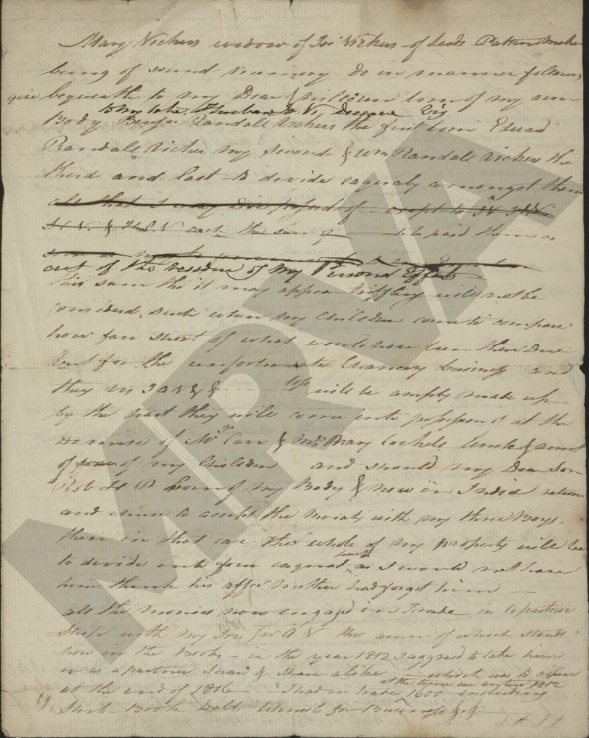
In her 1817 will, Mary wrote “All the monies now engaged in trade in partnership with my son John A V, the amount of which now stands in the books (in the year 1812, I agreed to take him in as a partner, share & share alike, which was to expire at the end of 1816). I had in trade at the time we entered 1812, £1600, including Stock, Book Debts.” Since Mary got back only £400 from the arbitration process, it suggests that the joint business had not gone well.


Comments