top of page

Marshall vs Vickers – High Court of Chancery, c.1811-1818

  • Writer: Peter Vickers
    Peter Vickers
  • Jul 8
  • 3 min read
In 1818 the High Court of Chancery in London ordered the sale of fourteen (14) properties in Leeds city centre which belonged to Mary and Joseph Vickers, in settlement of a claim made against Joseph’s estate (note that he had died ten years earlier – Chancery court cases were a notoriously slow process, as satirised by Charles Dickens in “Bleak House”).  The claim was brought by a London wholesale grocer (and future Lord Mayor), Chapman Marshall, presumably over a large unpaid debt. 

This lengthy case changed the Vickers family fortunes. The MRV Archive has no papers which directly bear on this case, bar one tantalising line in Mary’s 1817 will: “This sum, tho’ it may appear trifling, will not be considered such when my children come to “compass” how far short of what would have been their due but for the unfortunate Chancery business”.  
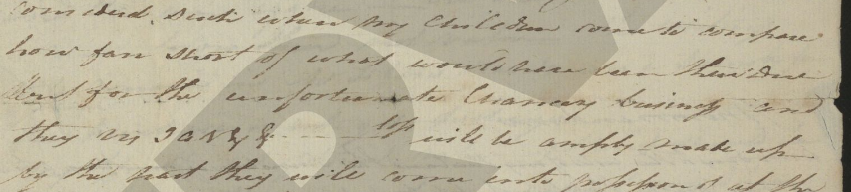
Reference to the 'unfortunate Chancery business' in Mary Vickers' draft will, 1817 (click image to view full version)

However the Chancery Court records at The National Archives in London include four sets of documents concerning this claim / case. The contending parties were: 

Complainants / Plaintiffs: Chapman Marshall, Samuel Hanson, John Smallpiece on behalf of themselves & all the other creditors of Joseph Vickers (deceased)
 
  • Chapman Marshall was a London based grocer / businessman.  Born in 1786 in Peterborough, the son of a wholesale grocer there, he moved to London & was married in Deptford in 1807.  By 1815 he was living on Upper Thames Street (east of Blackfriars, a warren of riverside warehouses).  His business prospered so much that later he became an Alderman & Lord Mayor City of London, was knighted and was Lord Mayor of London in 1839.  

Defendants: Mary Vickers, John Carr, William Hett, John Ash Vickers, Benjamin Randall Vickers (BRV), Edward Randall Vickers (ERV) and William Randall Vickers WRV), infants (by William Stoney, their Guardian), William Carpmael and Sarah his wife, Harriet Carr Vickers and Joseph Cockell Vickers, an infant (by the said Harriet Carr Vickers his Guardian) 

  • John Carr was probably Mercy Carr’s brother, ie Joseph Vickers’ brother-in-law from his first marriage  
  • William Hett was a wool stapler on Albion Street – he himself was made bankrupt through legal proceedings 1809-1811 
  • BRV, ERV and WRV were represented by their Guardian, William Stoney, who is one of the Witnesses in this case, described as “late a Grocer”. 

The original complaint is unknown (it is not stated in the surviving records) but we assume it would have been for an unpaid debt owing to the Complainants from (following his death) Joseph Vickers’ estate.  

Mary’s Deposition in this case confirmed that Joseph died in possession of nineteen properties in the centre of Leeds: eight dwellings in St Peter’s Square and eleven commercial / residential properties on Briggate.  This is a much larger “family property portfolio” than had been previously known. 

The case dragged on for seven years. Eventually, Mary and her co-defendants lost the case, resulting in a court order to sell fourteen lots of property.    

The “Morning Chronicle” of 12 February 1818 and the “Leeds Intelligencer” of 23rd February 1818 announced that an enforced sale of most of Joseph Vickers’ properties was to be held on 1st April 1818, at the White Horse Inn, Boar Lane, “pursuant to an Order in the High Court of Chancery, made in a Cause MARSHALL against VICKERS with the Approbation of William Courtenay, Esq, One of the Members of the said Court”.   

The sale would comprise fourteen lots comprising “certain Messuages, Tenements, Shops, Warehouses, and other Buildings and Premises, situate in the Street called Briggate, in the Town of Leeds aforesaid, and also several Messuages or Dwelling-houses, situate in St Peter’s Square in Leeds aforesaid, late the property of Joseph Vickers, deceased.” 

The West Yorkshire Register of Deeds record that ten properties on Briggate (including “…shops situate on the east side of and fronting onto Briggate…”) were sold in July 1818 to a Mr. Hirst; and a further parcel of four properties “on the west side of St Peter’s Square” were sold in September 1818 to a Mr. Barker. 

It is obvious that the sale of 14 of Joseph’s 19 properties in Leeds would have had a significant effect on the family assets and income. Of course, they were not left penniless – they still had five properties in Leeds and the patten business – but it would have been a hard blow.   

One sympathises with Mary’s phrase, “that unfortunate Chancery business”.   
But it might also be that the loss of the income from these properties was one of the factors which, ten years later, would lead Benjamin Randall Vickers to start a new business as an oil merchant… 


Comments


bottom of page