Mary’s children and step-children

Jul 21
10 min read
Mary bore four sons who reached adulthood (one by her first husband, three more by her second), as well as another who died in infancy. She also raised another four step children who came with her second husband. They had varied, interesting lives - merchant, patten-maker, preacher, printer, publican, sailor, soldier, surgeon, and of course as spouses and parents.
MARY’S CHILDREN WITH SAMUEL PHILIPPS:
Robert Howl Philipps (1788-1830)
Robert Howl Philipps had in 1808 joined the East India Company, a very large and wealthy private company (founded in 1600 to trade in the Indian Ocean area) which effectively ruled “British India” including most of modern day Bangladesh, India, Myanmar and Pakistan, until the Government of India Act 1858 (the year after the Indian Revolt) gave the British Crown and government direct control. It has been said that the Company rose to account for half of the world’s trade during the mid-1700s and early 1800s.
Robert seems to have had a very successful career there and seems to have learnt at least one of the local languages (see Moses’ letters to Mary, 6th March 1824 and 22nd October 1825). Robert took part in the First Anglo-Burmese War (1824-26) which ended in British control over several regions of Burma (now Myanmar) including Arakan (now Rakhine). Robert, holding the rank of Captain, became Assistant Commissioner for Arakan and Governor for three provinces recently seized from the king of Ava.
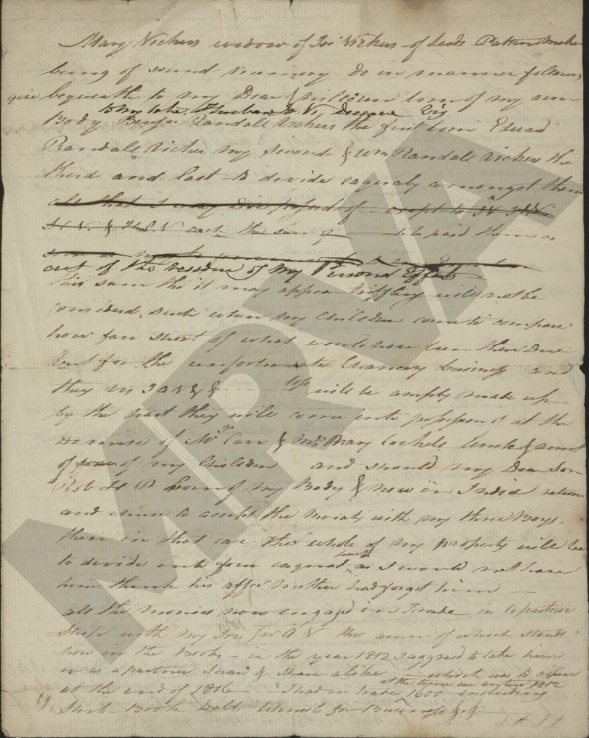
Mary was clearly fond of her first born, dear, son. In her last Will she bequeathed “My portrait painted by Arrowsmith to Benjamin‘s care for my dear Robt Howell Phillips now in India also my portable desk and should he not return and a convenient opportunity offer, to have a ring sent in memory of an affectionate mother” while yet leaving him out of any financial legacy on the grounds that “My dear son Robert H Philipps will not on his return to his native country ever charge his Parent with forgetfulness but under a firm persuasion the rank he holds in the East India Company’s service will place him above his Brothers and cannot wish to share a few pounds with them.”
One of Moses Randall’s letters to Mary (6 March 1824) refers to Moses’ willingness to hold a “Welsh Bible for your son and most gladly will restore it to him, if he should wish to possess it as having been the property of his grandfather”. This, and the spelling of Howl, clearly indicates that Samuel Philipps’ father, Robert’s grandfather, had been Welsh.
However, Robert was never to return. He died in Arakan in 1828, leaving a common law Indian wife and four children surnamed Philipps: Harriet (11 years, eight months); Samuel (7 years, 9 months); Anthony (5 years, 10 months) and George (2 years, 10 months). Revd. W. Hovenden, the Secretary of the Military Orphans School (for East India Company employees’ children) in Khidirpur / Kidderpore, Kolkata / Calcutta asked (in a letter dated 16 May 1829, addressed to Rickards Mackintosh, one of the agencies which handled matters for the East India Company) that Robert’s beneficiaries, his three Vickers half-brothers, be urged to give their inheritance of c £130 each (about £75,000 in December 2025) to pay for these children’s education.

This request was sent on by Rickards Mackintosh in London to Mary’s eldest son with her second husband Joseph, Benjamin Randall Vickers (known as “BRV”).
Benjamin agreed but his two brothers, Edward Vickers and William Vickers, did not; however the vessel carrying Robert’s belongings back to Britain was shipwrecked and his belongings were lost, so they did not benefit as much as they may have hoped.
Samuel Philipps (1789-90)
Born just before his father’s death, Samuel contracted smallpox as an infant and died aged about 18 months old. He was buried in his father’s grave in St John’s Churchyard, Leeds.
MARY’S STEP-CHILDREN
All of Mary’s four step-children, from Joseph Vickers’ marriage to Mercy Carr, seem to have had difficult times and made some unfortunate choices, despite her efforts to teach and support them.
Sarah Vickers (1786 -1865)
In September 1807, aged 21, Sarah married William Carpmael, son of an innkeeper in Halifax & described on the marriage register as a grocer.
Money seems to have been often short and there were several begging letters to Mary from her stepdaughter, Sarah, including one in 1812 when she did not know where her husband was.

In 1817 Sarah and William bought the Upper George Inn in Halifax (UK), from William’s widowed mother – Mary lent them £100 to do so. At some point Sarah and William moved to Lancashire.
They had two daughters, Jane (b.1810; she later married and lived in Prestwich, north of Manchester) and Harriet (b. 1812, who later married George Bevins in Liverpool. Both Harriet’s father and new husband are described on her marriage certificate as “Travellers” which probably means they had no fixed employment).
Both William (1854) and Sarah (1865) died and were buried in Manchester.
Harriet Vickers (1788 - 1870)
Harriet features in the writings and correspondence of various family members, most witheringly in Mary’s private diary (September 1817) where she wrote “she has not one amiable trait in all her composition”.

There was a succession of suitors but none made a proposal. However in 1826, aged 38, Harriet married a ship’s steward, Archibald Brown, who worked on one of the East India Company’s ships trading across the world.
The romance had begun in 1824 (if not before) and when he returned in 1826 she refused to tell him whether she was still “Miss V” or if she were now “Mrs T.” On landing back in Gravesend from the West Indies, he sent her a jar of ginger on the express mail coach and told her that he had “£300 worth of contraband goods in London”; this is only the first example in the letters showing that he and other crew members regularly traded on their own account, bringing British goods to sell in India, the Straits of Malacca and China, and bringing back goods from those places to sell in Britain. He reckoned to clear £500 profit per trip, on top of his £100 fee from the East India Company for sailing the voyage in the first place (though he worked hard for his pay: up at 4am each day, for 18-20 hour days).
Harriet and he married in August 1826 (two months after Mary’s death) and moved to London; but they spent much of the next years apart because of his trips. He is startlingly frank about his life, at one point writing (from Canton, December 1827) that he was with “my China wife…(don’t feel too much jealousy as it will be of no use)…I have sold my other wives for Your benefit, only now retaining three of them”. One can only imagine how Harriet felt about that. Yet, despite his behaviour, there is in all his letters a tenderness and sincerity about his concern for Harriet which also rings true.
In 1829 he asked her to join him on St Helena, where he had “signed an agreement on which the future prosperity of my life depends”. She refused, but (according to BRV) later regretted it; they never met again, although she lived another forty years, initially in London (where her half-brother, William Vickers, supported her with a quarterly postal order for 15 shillings) but later in Leeds, for her grave is said to be in Chapel Allerton churchyard.
John Ash Vickers (“JAV”) (1791-1828)
John Ash Vickers was probably already training as a patten maker, working alongside his father Joseph, before the latter’s death in 1808. Mary’s venture in taking him into the patten making business did not go well, and she had to enforce arbitration clauses written into their partnership agreement. (Please see the article on “Mary and John Ash Vickers” for full information about JAV’s life, by clicking here.
One can well imagine that relations between JAV and his step-brothers was strained (to put it mildly). But there seems to have been a reconciliation before Mary died: Moses’ letter to her of 16th January 1826 describes Moses’ amazement at the “family feud reconciliation”:

BRV’s description of Mary’s last days in his “Sketch…” records her words when they stood together at her bedside: “All breaches are healed up, therefore live as brethren, live in peace, may you be a threefold cord that cannot be broken.”

She urged JAV to have a personal experience of Jesus (“Oh get Religion, nothing will do short of a personal interest in Christ by the forgiveness of sins. You must have personal religion.”) Sadly, less than two years after Mary’s death, JAV was declared bankrupt (Announced in, eg, the “Devizes & Wiltshire Gazette”, February 23rd, 1828).
Allegedly he then fled to Manchester to avoid his creditors; but, on running out of money altogether in November that year, he returned to his home in Leeds and there died by suicide. He was buried at Brunswick Chapel on 9th November 1828, although his final estate was not legally wound up until 1831.
Joseph Cockell Vickers (“JCV”) (1796 - 1835)
Having done an apprenticeship as a bookseller and printer with Hartley’s in Rochdale, Joseph Cockell Vickers ("JCV") became a “printer, bookbinder & stationer” operating at 4 Birch’s Yard, off Lower-head Row and living at 36 Trafalgar Street (close to where his stepmother Mary spent her last years).
In 1823, whilst in Rochdale, JCV married Elizabeth Stott, daughter of a solicitor in that town. JCV’s half-brother, Edward Randall Vickers, was one of the witnesses to the wedding. JCV and Elizabeth had two children, Richard and Annie (see below).
BRV reported later that the Stotts were a passionate family, so much so that one of her brothers killed another one in a quarrel.
JCV was due to be one of the beneficiaries from his aunt and uncle Mr. Carr and Mary Cockell (his mother’s relations in the woollen cloth trade) so he expected, and may actually have, inherited a significant sum from them. None the less, JCV was declared bankrupt in January 1829.
He died six years later, in 1835, aged 39, and was buried at St Mark’s Churchyard, Woodhouse, Leeds. Both of JCV’s children later migrated to Australia:
Richard Edward Vickers (1824 - 1880). In 1850 Richard married Margaret Hope (née Bain) from Manchester; the marriage certificate describes Richard as a Hosier, living on Briggate. They are listed in the 1851 Census as living at 94 Briggate; Richard’s profession is now “Outfitter”. Ten years later, in 1861, Richard is living with his mother, Elizabeth, at 92 Briggate, and is described as Hosier & Shirtmaker. After his wife died, Richard emigrated to Australia; he died in Melbourne in 1880.
Annie Holland Vickers (1827-1884) whom it is believed married Musgrave Wilkinson and emigrated to Australia and later died there; “The Argus” (Melbourne) has a death notice on Tuesday 16 December 1884 for an Anne Holland Wilkinson, aged 57, who lived at Grace Street, Moonee Ponds, Melbourne.
MARY’S CHILDREN WITH JOSEPH VICKERS
Benjamin Randall Vickers (“BRV”) (1798-1881)
Mary and Joseph’s eldest son, Benjamin Randall Vickers (“BRV”) was a remarkable personality in his own right.
BRV was ten years old when his father, Joseph Vickers, died; he then went to a boarding school in Attercliffe near Sheffield but “when between 13 and 14 I left school; and as the law made every son who was not apprenticed before he was 14 years old liable to be balloted for the militia (ie, local defence forces raised across the country against the risk of invasion by Napoleon), my mother got me apprenticed to Messrs Butterworth & Co, Engravers”.
There is charming evidence of this engraving apprenticeship from Mary’s card for her patten business; the metal printing press plate with her details carries, in very small words, the phrase “B.R. Vickers – Sculpt”.

BRV was a convinced Methodist preacher from teenage years, later helping to found two Methodist chapels. After his apprenticeship, he worked with his mother and one brother as patten-makers, started a new business (selling oils), was married and widowed thrice, outliving them and all his siblings and step-siblings.
His story, and that of the oil business he founded, will be explored fully in future.
Edward Randall Vickers (“ERV”) (1799-1845)
Edward joined his mother and brother (BRV) in the patten making business in 1824. Included in the draft Articles were the following “Important Particulars”:
No suspicion of each other’s integrity
If anything feels wrong, talk with the other brother before talking to anyone else
Never speak of the other’s faults in the hearing of another person (the same for disputes unless absolutely unavoidable)
Once a matter is settled, it should stay settled
If either party has anything to say against the other, say it at the first opportunity”
After Mary died, BRV realised that the business would not support the two brothers so reduced his share in it from one-half to one-third. Edward went on into shoe making and later became a commission agent.
In 1832 Edward married a local beauty, Caroline Wrigley (connected to the chewing-gum family), but died at the early age of 47 in 1845. He was buried in Brunswick Chapel churchyard, which no longer exists.
After his widow alienated all their friends, Edward’s brothers Benjamin and William underwrote the cost of their four children’s education.
William Randall Vickers (“WRV”) (1801-1856)
William, the youngest of all Mary’s children, was clearly very talented and able, as can be seen by the beautifully presented trigonometry in his Mathematics book (sometimes setting the maths puzzle around a castle or a tree).

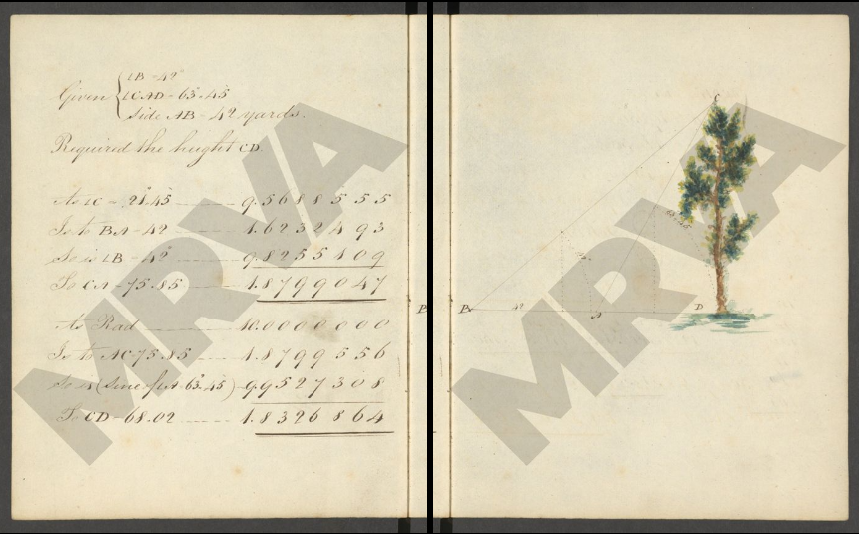
By the time he was 21 he was studying medicine in London, training to become a surgeon. By 1829 he was established as such in Manchester Square, London and later was based at 32 Baker Street (Portman Square).
But his scientific interests clearly reached into other matters: the Official Catalogue, Class VIII, of the 1851 Great Exhibition (held at the Crystal Palace), lists him as the designer of a “geometrical floating life-belt, made of sail canvas and divided into five compartments, stuffed with cork cuttings….The life-belt can be folded up nearly into a cube, and made to serve as a cushion on board ship….It is made to surround the body of the wearer and leave his arms free”. It sounds practical, but there is no record of his idea ever being taken up.
William married Amelia Cole from Devon; they seem to have been a lively and fun couple. (That said, he was vexed by the conversion of his uncle, John Smalpage, to Catholicism.) He remained close to his step-sister Harriet Brown and supported her financially up to the time of his death in August 1856. There is a moving account of his last hours described in a letter from BRV to Harriet.


Comments