The Randall Family: Mary Randall Vickers' Birth Family in Leeds

Jun 4
6 min read
Updated: Jun 5
Mary Randall’s parents, Robert Randall (1730-1796) and his wife Rebekah (née Flocton, 1734-1796) married in 1754.
The oldest item in the entire Mary Randall Vickers Archive is a recipe book owned by Rebekah Randall, dated 1766, 'English Housewifry' written by Elizabeth Moxon.
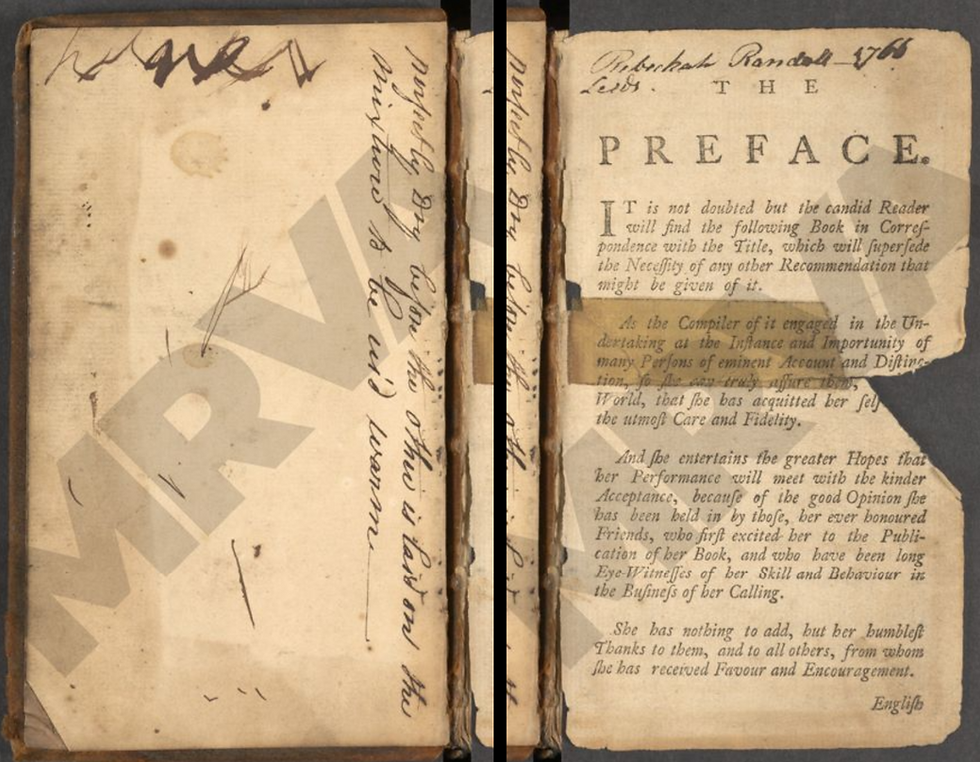
The book contains recipes for food and drink, menu plans and instructions on how to set out food and drink for each season of the year. The book contains annotations at the front and rear of the book, made by Rebekah and possibly by her eldest daughter, Mary.
Rebekah gave birth, over the next eighteen years, to eleven children, of whom three (Samuel, Ann and Thomas) died as infants and another (John) as a young teenager. Mary was the oldest of the seven children (Mary - 1757, Robert - 1758, Rebecca - 1760, Joseph - 1765, Benjamin - 1767, and Miriam & Moses (twins) - 1769) who reached adulthood.

The baptismal records for Mary and her brother Robert show that the family was living in Meadow Lane, on the south side of the River Aire, until at least 1758. But the next child, Rebecca (born 1760), and all the other children had their address at baptism registered as Briggate, where the family grocery & cheese-monger businesses operated. The move over Leeds Bridge to live on Briggate would have been significant – Briggate was one of the two major commercial streets in Leeds and the family’s move happened as Leeds’ population was soaring.
Mary’s father, Robert Randall, had been born in 1730. As yet, it has not been possible to trace his own back history, although there is some suggestion that other family members (cousins?) may have lived nearby and been in the same trade. Mrs Eve Randall, who lived in St Peter’s Square, Leeds, close to Mary, died in 1827 aged 100; she is said to have been Robert Randall’s sister-in-law.
The 1790 Leeds Directory denotes Robert Randall (senior) by an “(F)” indicating that he was the Freeholder of the property in Briggate:

Robert ran his business so well that, over time, he became prosperous enough to be a member of, and regular investor in, the “Boggart Close Greater Building Society (St Peter’s Sq.)” A list of its members in 1789 shows that Robert Randall, Grocer, owned nine properties in St Peter’s Square, Quarry Hill (now the site of the Leeds Playhouse). Other records of property ownership, revealed through the ratings records, confirm that “Randall” owned 9 properties on Quarry Hill both in 1790 and 1795, increasing to 11 in 1800 before dropping to 10 in 1805.
The burial listing for Robert (senior) in 1796 states that he was then living in St Peter’s Square, no longer on Briggate. St Peter’s Square would be Mary’s home for most of the rest of her life. The photograph below shows St Peter’s Square in 1908:

Mary’s closest sister, Rebecca (three years younger than Mary) died in 1783, aged 23. Her youngest brother, John, died in 1787, aged only 15. Six years later, Mary’s closest sibling, her brother Robert Randall (junior), died aged 35. Two and a half years after that, in January 1796, her father Robert (senior) died, aged 66; Mary was appointed as an executor in his will. In December of that same year, 1796, both her mother Rebekah (aged 65) and her next brother Benjamin (aged 39, described in the burial listing as a cheesemonger) died within three weeks of each other.
Mary suffered eight immediate family losses (including her own first husband and second son, both of whom were named Samuel Philipps, in 1789 and 1790 respectively) in only 13 years. By 1797, Mary was left with just three younger siblings – Joseph, Miriam and Moses Randall, and a young son – Robert Howl Philipps.
After Mary’s marriage to Joseph Vickers (Joseph V), the Randall grocery business was taken on her new husband in partnership with her brother, Joseph Randall (Joseph R). Their partnership lasted four years (1800-1804) and then was continued solely by Joseph V.
Joseph R was bankrupted in 1808 and seems to have then moved to London. A letter to Mary from Joseph R (August 1812) reveals both that he was acting as an agent for Mary’s grocery business, buying sugar for her on the London market, and that Mary had lent him money (perhaps as a cash float to finance his trading).
Joseph R died on January 16th, 1814 and was buried in Clerkenwell. Mary wrote in her journal “Thus begins the new year with bereavement. Oh! The painful sensation which is ever the attendant of separation from those we tenderly love. He was indeed to me a Blood Brother.”

In the latter stages of her life, Mary was close to her twin siblings, Moses and Miriam Randall, about whom we know more than most of her other brothers and sisters. They were born in November 1769, so were almost thirteen years younger than Mary.
Moses Randall got a place, aged 21, at Sidney Sussex College, Cambridge in 1790 as a “sizar” (ie an undergraduate who received financial help from the college). Moses was ordained as a minister in the Church of England (ie not as a Methodist); his first parish was in Holme-next-the-Sea (close to Hunstanton) in Norfolk. Later he moved to Manchester and in 1804 was commissioned as Chaplain to the Hulme Volunteer Infantry, one of many volunteer militias which were raised around the country during the Napoleonic Wars, to defend Britain should there have been an invasion (which of course never happened).
More correspondence from Moses has survived than from any other person. He comes across as a slightly fussy man, concerned about money – we know that he was a book collector and built up a library which after his death was auctioned by one of Manchester’s leading booksellers, John Ford – but clearly very respectful to, and very fond of, his oldest sister.


Comments